Let’s start with a slightly uncomfortable truth:
The way we’ve been farming for the last 75 years is… not going great.
Industrial agriculture has done an impressive job of feeding billions of people. Credit where credit is due. But it has also come with a cost—soil degradation, water depletion, biodiversity loss, and a growing dependence on chemical inputs that, quite frankly, feel like a short-term fix with long-term consequences.
Here’s a stat that should get your attention:
According to the Food and Agriculture Organization, roughly one-third of the world’s soils are already degraded, and if current practices continue, we could be looking at serious limitations on global food production within the next 40–60 years.
So yes… this matters.
This isn’t just a conversation for academics or farmers—it’s a conversation about whether our kids and grandkids will actually have healthy soil to grow food in.
So… What Is Regenerative Farming?
Regenerative farming is not a trendy buzzword (although it has definitely become one). At its core, it’s about working with natural systems instead of overriding them.
It’s about:
- Building soil instead of depleting it
- Increasing biodiversity instead of simplifying ecosystems
- Holding water in the land instead of letting it run off
- Producing food in a way that heals the environment rather than extracting from it
Simple concept.
Very complex in practice.
Our Accidental Journey into Regeneration
When we purchased Spirit Mountain back in 2003, I’ll be honest—I wasn’t using the term “regenerative farming.”
I was just trying not to mess up a beautiful piece of land.
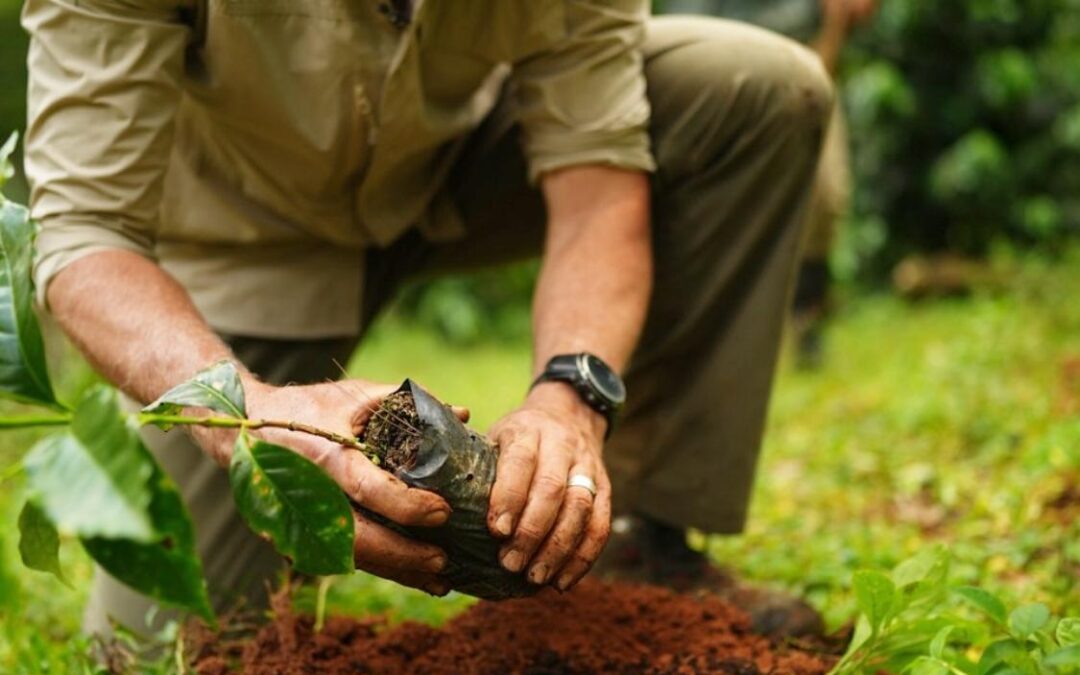
What started as instinct—planting trees, protecting water, letting nature breathe—has, over time, become a layered agroforestry system that aligns very closely with what the world now calls regenerative agriculture.
And the longer we do this, the more we realize… we’re just scratching the surface.
What This Looks Like on the Ground
At Spirit Mountain, regeneration isn’t a theory—it’s dirt under your fingernails.
Multi-Layered Agroforestry
Our coffee doesn’t grow in isolation. It grows under a canopy of diverse tree species—native hardwoods, fruit trees, nitrogen-fixing species—all working together.
We’re not just growing coffee.
We’re growing ecosystems.
Letting “Weeds” Be… Well, Not Always the Enemy
We allow a controlled amount of ground vegetation to coexist with our crops. Why?
Because those “weeds”:
- Protect soil from erosion
- Retain moisture
- Add organic matter back into the system
Turns out, nature knows a thing or two about ground cover.
Wild Pollination
We actively support wild bee populations across the farm. No imported systems. No over-management.
Just healthy ecosystems doing what they’ve done for thousands of years—pollinating life.
Intentional Biodiversity
We’ve planted tens of thousands of trees over the past two decades—many specifically chosen to:
- Feed people
- Support wildlife
- Attract bird species
- Build long-term soil health
And yes… the birds have noticed.
Why This Matters Beyond the Farm
Here’s where things get really interesting.
Regenerative farming isn’t just changing agriculture—it’s reshaping how people travel, live, and connect.
The global agritourism market (yes, that’s a thing now) is growing rapidly—estimated at over $60 billion globally and projected to more than double in the next decade. People are actively seeking out places where they can:
- Understand where their food comes from
- Experience nature in a meaningful way
- Disconnect from noise and reconnect with something real
This is where farms like Spirit Mountain step into a much bigger conversation.
We’re not just producing coffee.
We’re creating a place where people can experience regeneration—personally and environmentally.
The Nexus: Farm + Community + Experience
This is the part that gets me excited (and yes, this is where I tend to go long… I’ll try to behave).
At Spirit Mountain, we are intentionally bringing together:
- Regenerative agriculture
- Residential community (Estancia Natura)
- Hospitality and eco-tourism
- Recreation (trails, biking, exploration)
And here’s the thesis:
👉 When done well, these are not competing uses.
They actually strengthen each other.
People who live here understand the land.
People who visit here are changed by the experience.
The farm benefits from both.
And somehow… everyone leaves better.
The Healing Part (That You Can’t Quite Put in a Spreadsheet)
There’s something that happens when you spend time on a regenerative farm.
You hear it first—birds, wind, silence.
Then you feel it—bare feet on grass, dirt on your hands.
Then, slowly, something shifts internally.
Call it rest.
Call it clarity.
Call it healing.
I don’t fully understand it.
But I’ve seen it happen over and over again.
Why We’re Sharing This
We’re not claiming to have this figured out.
We are learning. Experimenting. Failing. Adjusting. Trying again.
But we are convinced of this:
The future of farming—and maybe the future of how we live—is regenerative.
And we want to invite others into that journey.
Through Estancia Natura, through our hospitality efforts, through the farm itself—we are building a community centered around:
- Respect for nature
- Authentic relationships
- A shared desire to do better
Final Thought
Regenerative farming is no longer a niche idea for the “granola crowd.”
It’s quickly becoming a necessity.
The real question isn’t just:
“Can we do this?”
It’s:
“Should we keep doing it the old way?”
At Spirit Mountain, we’ve chosen a different path.
Not because it’s easy.
But because it feels right.
And if you’ve been following along, or maybe just discovering us—
There’s a place for you here.
Chad and our Farm Team